 ...
...
 click to enlarge
DNA: The Molecule of Life, Oak Ridge National Laboratory
Through him all things were made; without him nothing was made that has been made. John 1:3 NIV
As the field of genetics emerged in the early twentieth century, it became apparent that Darwinism's natural selection and adaptability were not sufficient as sole contributors to the creation of new species. The combination of Darwinian theory and genetic mutation, however, "seemed" to present a more credible evolutionary approach, now referred to as neo-Darwinism. Where Darwinism alone could not provide a framework for creating new species, neo-Darwinian thinking was expected to close the gap and supply the missing pieces. In addition to genetic mutations, the modified theory still relied on the availability of time and chance as contributing agents for change.
DNA
The discovery in 1953 of the double helix, the twisted-ladder structure of
deoxyribonucleic acid (DNA), by James Watson and Francis Crick marked a milestone in
the history of science and gave rise to modern molecular biology, which is largely
concerned with understanding how genes control the chemical processes within cells.
In short order, their discovery yielded ground-breaking insights into genetic code
and protein synthesis.
The Francis Crick Papers: The Discovery of the Double Helix,
1951-1953, Profiles in Science, National Library of Medicine
The following briefly describes the complexities of DNA and its role in providing irrefutable evidence in the Creation/Evolution debate. Even if there were millions of years with billions of genetic mutations (copying errors), the creation of the DNA molecule, and of life itself, remains impossible without a predetermined design plan. The double-helix DNA molecule and the human brain are perhaps the most intricate structures in the universe. DNA is but one component of the complex "machinery" that resides within the cell wall.
The embedded DNA consists of a "list" of instructions decsribing every detail of the organism. DNA is structured as a double-helix molecule, envisioned as "rungs on a ladder" with each "rung" termed a base pair. Each DNA strand has ~3 billion base pairs that comprise 20-25,000 genes. Genes are further organized into 23 pairs of chromosomes. To understand the magnitude of complexity designed into the genetic system, chromosome 1 consists of 249 million base pairs. If unwound, a single DNA molecule would stretch to a length of ~6ft (2m). Of the ~30 trillion cells in the human body, 80% are red blood cells which do not have a nucleus. The remaining 20% (~6 trillion cells) have a nucleus which includes DNA.
It defies the imagination to even attempt to understand how evolutionary philosophy can suggest that a random, unguided process could create such a complex set of steps through a chain consisting of over 3 billion coded instructions (base pairs), each requiring a very specific combination and order.
...
click to enlarge
DNA: The Molecule of Life, Oak Ridge National Laboratory
DNA Replication: The animation (below) demonstrates the process by which DNA is replicated, presenting only a small part in the process of God's creation of life. The animation should surely raise doubt as to how this amazing "machine" could have evolved by time and chance alone, and without the intervention of intelligence and design.
DNA replication is the process of producing two identical copies from one original
DNA molecule. This biological process occurs in all living organisms and is the
basis for biological inheritance. DNA is composed of two strands and each strand of
the original DNA molecule serves as a template for the production of the
complementary strand, a process referred to as semiconservative replication.
Cellular proofreading and error-checking mechanisms ensure
near-perfect fidelity for DNA replication.
Wikipedia: DNA Replication
DNA Replication Animation select image
yourgenome.org, YouTube
DNA Mutations
DNA mutations are a result of copying errors during replication. The discussion below may help
to raise common sense questions regarding the notion that mutations can direct evolutionary design
without intelligent planning. The opposable thumb on the human hand will serve as an example.
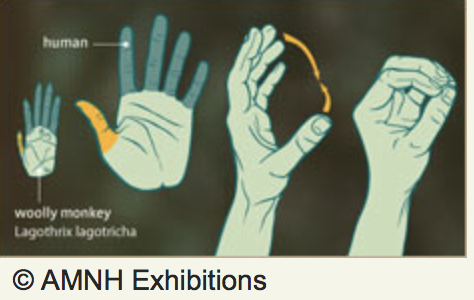
The Grasping Hand: The grasping hands of primates are an adaptation to life in the trees.
The common ancestors of all
primates evolved an opposable thumb that helped them grasp branches. As the grasping hand evolved,
claws disappeared. Today, most primates instead have flat fingernails and larger fingertip pads, which help
them to hold on. The hands of many higher primates can grasp and manipulate even very small objects.
--------------------
What makes human thumbs unique?: The human opposable thumb is longer, compared to finger
length, than any other primate thumb. The long thumb and its ability to easily touch the other
fingers allows humans to firmly grasp and manipulate objects of many different shapes. The human
hand can grip with strength and with fine control, so it can throw a baseball or sign a name on the
dotted line.
The Grasping Hand, American Museum of Natural History (amnh.org)
Comment: Although adaptation and mutation are presented as agents of evolutionary
development, progeny are still of the same species. Genetic drift, natural selection, and adaptation are among
the causes of
variation within species and families; a process called micro-evolution. As an example, the created
wolf/dog kind
would have all the genetic traits to produce variation (various breeds, sizes, temperament, etc.) but
cannot create a new and totally unrelated family, even if millions of years were available.
Evolutionary change that supposedly creates a new family is termed macro-evolution, or, the creation of
an entirely new and identifiable organism. The most prevalent force for macro-change, according to the annals of
evolution, are
genetic mutations. These mutations are rare and predominantly occur during the DNA replication process.
Mutations are copying errors that are either neutral or lethal. It is also possible that mutations could contribute to a
positive outcome but are not in any way capable of creating a new species. The additional "Grasping Hand" comments
below may help to understand why an organism cannot increase in complexity per the story told by neo-Darwinian theory.
The American Museum of Natural History (AMNH) cites the opposable thumb as simply a continuum of
evolution in action. The fact is that climbing trees can no more cause change in a species than living in a
tree house.
Consider the fact that a change, even a localized one such as the opposable thumb, would require an
undeterminable number of mutations with all occurrences having a focus on renovating the appendage.
The AMNH states that due to the dexterity of the thumb, "The human
hand can grip with strength and with fine control, so it can throw a baseball or sign a name on the
dotted line."
Even if there were thousands of mutations to work with, there is no reason that any
would continue to advance the evolutionary process. Evolution is dependent upon mutations
(copying errors) and
is not guided by intelligence or planning. In summary, every mutation would occur independent from
the previous
and there is no scientific principle that would cause it to act in concert with its predecessors. A hand
with an opposable thumb would require an intricate design that includes nerves, muscles, bones,
tendons, arteries, veins, etc.; all working in coordination with the hand, arm, and brain. One would
have to admit that the design of even
one lonely appendage would require engineering skills that are non-existent at any natural level.
Evolutionary genetics has determined that the rate of mutation is highly variable but still contends that a calibration can be made to fit what is identified as the molecular clock. The "clock" is supposedly useful to evolutionists when calculating the divergence of a species from its parent.
The DNA replication process is intricate to the extreme and there is no doubt that mutations occur. It is scientifically elusive, however, to attempt to gauge a rate of mutation over great ages since a mutation is a random copying error. As mentioned previously, the problem is further compounded when presented with the fact that there is no available scientific mechanism that even hints at the possibility of a copying error building on the previous errors to form a more complex organism?
The University of California Berkeley has information on its web site describing the Molecular Clock. The following is an excerpt:
For the past 40 years, evolutionary biologists have been investigating the
possibility that some evolutionary changes occur in a clock-like fashion.
Over the course of millions of years, mutations may build up in any given stretch
of DNA at a reliable rate. For example, the gene that codes for the protein
alpha-globin (a component of hemoglobin) experiences base changes at a rate of .56
changes per base pair per billion years*. If this rate is reliable,
the gene could be used as a molecular clock.
Understanding Evolution, Molecular Clocks, University of California Berkeley
* notation included in the above article: This number is for changes that affect
the structure of the protein
Comment: Emphasized words in the above such as possibility or the inference that mutations may build up might be useful for scientific introspection to create an environment for testing, but they do not constitute discovery at any level. The mention of clock-like fashion suggests that a degree of accuracy exists that can be calculated over the millions of years period. The statement, "If this rate is reliable," places the entire argument in the category of subjective guesswork.
Is there a need for intelligence?
An extract follows from a more lengthy quotation by
Dr. George Wald, Nobel Laureate, regarding his belief in the formation of the first
cell. The quote
may be seen with more context in the chapter on The Origin of Life.
Given so much time, the "impossible"
becomes possible, the possible probable, and the probable virtually certain.
One has only to wait: time itself performs the miracles.
"The Origin of Life" Scientific American August 1954 p.46
Dr. Wald's belief in time, chance, and error represents just one of many such "ideas" posing as science that have strived to change the world view from one that is God-based to that which trusts in the concept of naturalism. The truth lies in the fact that the origin and complexity of life are beyond the understanding of science and human intelligence
Return to: The Complexity of Life
Please send comments or questions to: CreationOnLine@In6Days.org